How to apply for a RWVP as an interstate or overseas applicant
If you are in a different state to Tasmania, or overseas, you can still apply for a Tasmanian Registration to Work with Vulnerable People (RWVP). The application process you need to complete is different to that used by someone living in Tasmania.
This information explains how to apply for your RWVP from outside Tasmania, including how to have your proof of identity documents and photograph certified.
Get this information as a fact sheet you can print out (PDF, 608.4 KB).
I already hold the NDIS Worker Screening Check interstate. Do I still need to apply for a RWVP in Tasmania?
No, if you already hold a NDIS Worker Screening Check issued by another state or territory, you don’t need to apply in Tasmania.
The NDIS Worker Screening Check is nationally recognised, so you can also use it to work or volunteer in the NDIS in Tasmania.
See our NDIS Worker Screening Check webpage for more information.
How to apply for RWVP from outside Tasmania:
1. Prepare your proof of identity documents
Your proof of identity documents must be current, and must be:
- certified by a Justice of the Peace, Commissioner for Declarations, Notary Public, or other authorised officer (see below for examples of authorised officers)
- in English. If they are in another language, you must have them translated into English by an accredited translator. The translated documents must then be certified by a Justice of the Peace, Commissioner for Declarations, Notary Public, or other authorised officer.
See ‘Who can certify your documents and photo’ below to learn how you can find one, and ‘How to get your proof of identity documents certified’ below for what you need to do.
2. Prepare a photograph of yourself
This photograph must:
- meet Australian passport photo requirements. Go to the Australian Government’s Department of Foreign Affairs and Trade website for these requirements
- be certified by a Justice of the Peace, Commissioner for Declarations, Notary Public, or other authorised officer.
See ‘Who can certify your documents and photo’ below to learn how you can find one, and ‘How to certify your photo’ below for what you need to do.
3. Complete the RWVP online application form
- Complete the online application form.
- Upload your certified proof of identity documents and certified photo.
See ‘How to upload your documents and photo to your application’ below.
4. Pay the application fee online by credit card
Your application will not be processed until you have completed all of these steps.
How to certify your proof of identity documents
- Make a copy of the original documents.
- Take the original documents and the copy to the person who will certify your documents. They will check your copy is the same as the original.
- On a single-page document, the certifier must write or stamp ‘This is a certified true copy of the original as sighted by me’.
- On documents with more than one page, the certifier must write or stamp ‘I certify this and the following [number of pages] pages to be a true copy of the original as sighted by me’ on the first page, and then initial all other pages.
- The certifier must also write or stamp on the copy:
- their signature
- their full name
- their occupation
- the date
- their phone number (optional)
- their address (optional).
See examples of certified documents:
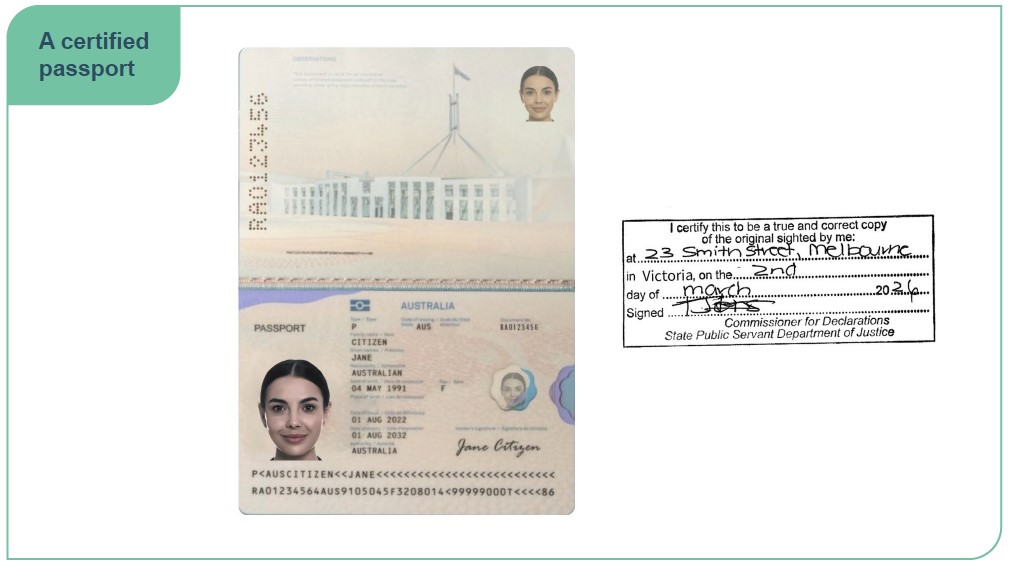
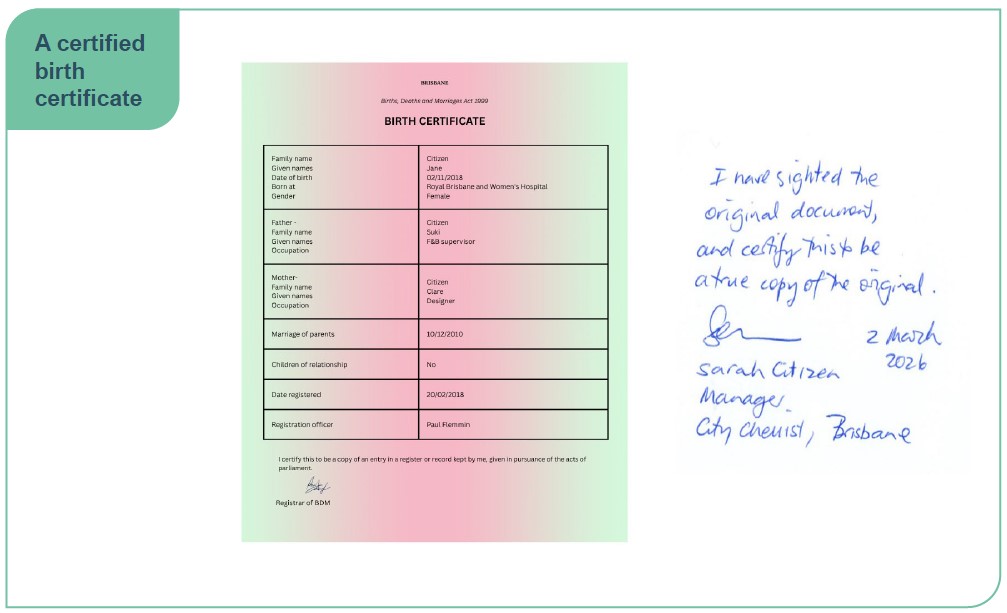
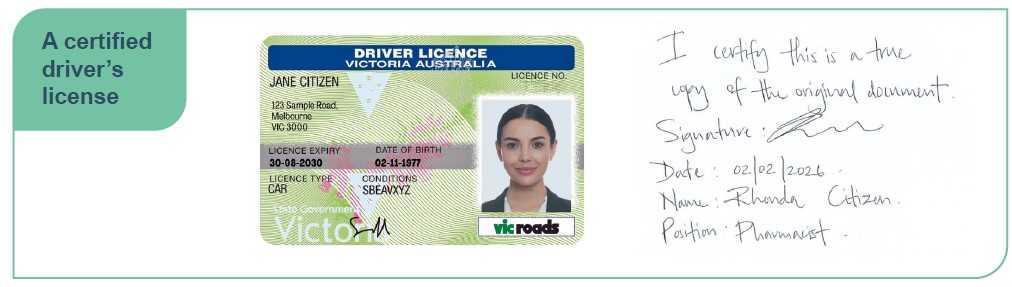
How to certify your photo
The best place to include the certification for your photo is directly beside the image, as shown in the example below.
Make sure that no certification text appears on the image itself, and that you provide these as one file/document only.
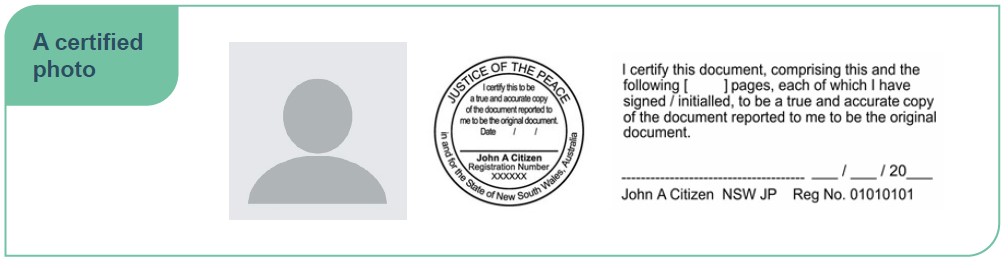
How to upload your documents and photo to your application
Make sure:
- you upload your documents and photos as either a PDF or .jpeg/jpg file
- you upload these at stage 6 “Supporting Docs” when you complete the online application form
- each file is no bigger than 15MB.
Who can certify your documents and photo
Your proof of identity documents can be certified in your state, territory, or country by a Justice of the Peace, Commissioner for Declarations, Notary Public, or another authorised person. You can search your state or country’s relevant government website to find these. Examples of authorised people may include:
- a police officer
- a lawyer or solicitor
- a pharmacist
- a medical practitioner (doctor)
- a nurse (registered or enrolled)
- a teacher (currently employed)
- an accountant (CPA, CA or IPA)
- a public servant (at a specified classification level)
- a bank officer (with at least 2 years of service)
- a postal manager
- a chartered engineer
- a chiropractor, dentist, optometrist, physiotherapist, psychologist
- a veterinary surgeon
- a minister of religion (recognised denomination).