This page provides information for current Justices of the Peace.
If you have any questions you can contact the Manager, Justices of the Peace.
Updating your details
The Department of Justice keeps the contact details of all JPs. Only the name, telephone number and suburb of JPs is available to the public.
You must advise the Secretary of the Department of Justice
- within 21 days if your name, residential address or contact details have changed (Justices of the Peace Act 2018 section 17)
- if you cease to be an Australian citizen
- if you become insolvent or have been charged with, or found guilty of, an offence punishable by a term of imprisonment of six months or more within 21 days after the charge has been determined.
You can either
- update your details using the Change your details form
- write to the Secretary of the Department at GPO Box 825, Hobart, 7001 or
- email JP@justice.tas.gov.au.
Applying for reappointment
Reappointment as a Justice of the Peace (JP) is for the term of two years commencing on termination of the current or immediately preceding appointment to the office of JP, under the Justices of the Peace Act 2018 .
As an appointed JP, you may apply for reappointment up to six months before or after you reach the age of 75 years, or within 6 months before or after the term of your appointment expires.
JPs can only reapply if
- you will be 75 years of age in the next six months or less
- you are 75 years of age, but have not yet reached the age of 75 years and six months
- your term of appointment will expire in the next six months or less
- your term of appointment has expired in the last six months or less
The Department encourages JPs who wish to be reappointed to apply within the six month period before they turn 75 or their appointment is expiring.
It is your responsibility to apply for reappointment before the end of your term. You may continue to seek reappointment every two years up to the age of 85 years.
Applications must be in the form approved by the Secretary.
To reapply
- submit the online reappointment form
- post to Secretary of the Department at GPO Box 825, Hobart, 7001, or
- email JP@justice.tas.gov.au.
Resign as a Justice of the Peace
At any time, you may resign from the office of Justice of the Peace by notifying the Secretary of the Department of Justice in writing, of your resignation, as set out in the Justices of the Peace Act 2018 (external link).
To notify the Secretary of the Department of Justice of your resignation
- complete the online resignation form
- write to the Secretary of the Department at GPO Box 825, Hobart, 7001, or
- email JP@justice.tas.gov.au.
Your resignation will take effect when the notice of resignation is received by the Secretary.
Legal Assistance
If you're involved in legal proceedings related to your duties as a Justice of the Peace, please contact the Department of Justice at jp@justice.tas.gov.au.
Justice of the Peace Guidelines
The Department of Justice have developed several Guidelines to assist Justices of the Peace in completing their duties;
Justice of the Peace Handbook
The Handbook for Justices of the Peace has been developed by the Department of Justice.
This comprehensive guide for practicing JPs in Tasmania, will provide you with a clear understanding of your role and act as a reference to help you perform your duties.
The Handbook can be used as a tool to help new JPs become familiar with tasks, and as an ongoing reference tool for existing JPs.
Witnessing Checklist
This resource contains checklists outlining the steps for witnessing documents and is designed as a reference for individuals who are already familiar with witnessing requirements. These checklists are specific to Tasmania to assist witnesses in properly attesting documents.
Tasmanian Association of Justices of the Peace
The Tasmanian Association of Justices of the Peace Inc promotes and supports JPs in delivering high quality services to the community. The Association plays a key role in enhancing the important work JPs do within the justice system by offering professional development and training, providing regular updates on changes to JP roles and procedures and creating opportunities for members to connect and collaborate.
While membership is voluntary, it is strongly encouraged to help ensure that Justices of the Peace continue to serve the Tasmanian public with excellence and professionalism.
If you are interested in joining the Association, you may contact the:
Tasmanian Association of Justices of the Peace Inc
GPO Box 805
HOBART TAS 7001
Email: secretary@jptasmania.com.au
Witnessing a statutory declaration
A statutory declaration is a written statement in which the person (called a declarant) formally declares before an authorised person that the statement is true. A statutory declaration is different from an affidavit in that it is not sworn or affirmed. A JP or CD is authorised to take a statutory declaration.
Statutory declarations have a wide variety of uses. In some cases, the law requires information to be supplied in the form of a statutory declaration. Insurance companies, banks, educational institutions, employers, clubs, government departments and other organisations often require information to be provided in the form of a statutory declaration. While statutory declarations are much less complex than affidavits they still carry a serious penalty for a false declaration.
Tasmanian statutory declaration
There are different versions of statutory declarations. If you are making a statutory declaration for a purpose under Tasmanian law, you must use the form prescribed under section 14 of the Oaths Act 2001 (Tas).
Example of the approved form:
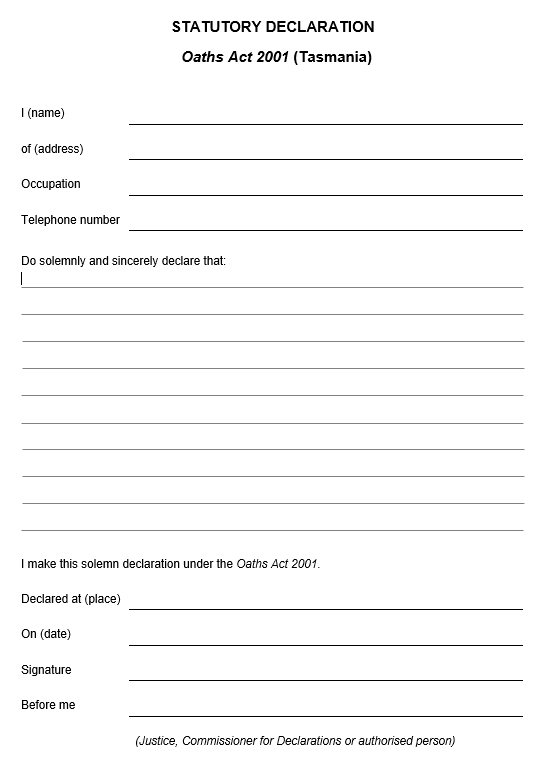
The statutory declaration form is available under 'Where can people get a statutory declaration?'
Commonwealth statutory declaration
A statutory declaration made for a purpose under Commonwealth law begins with the same words as a declaration under Tasmanian law. It must be in the form prescribed by section 8 of the Statutory Declaration Act 1959 (Commonwealth). The only difference between State and Commonwealth statutory declarations is the closing clauses. A Commonwealth declaration includes these words
I understand that a person who intentionally makes a false statement in a statutory declaration is guilty of an offence under section 11 of the Statutory Declarations Act 1959, and I believe that the statements in this declaration are true in every particular.
From 1 January 2024, changes to the Commonwealth Statutory Declarations Act 1959 introduced new ways to complete Commonwealth statutory declarations. Please note these changes only relate to Commonwealth statutory declarations. Each Australian state and territory maintains its own legislation and requirements for statutory declarations, which in most cases still require physical or remote witnessing by an authorised person such as a JP or CD.
The changes to the Commonwealth Act provide for the option to create and submit a Commonwealth statutory declaration online through the myGov platform, using an approved Digital Identity.
Where a person’s Digital Identity is verified at the required level, the declaration does not need to be witnessed by a JP or CD. These digitally completed declarations are legally binding under Commonwealth law.
Further information is available on the Attorney-General's Department website, including guidance on how to create a digital Commonwealth statutory declaration and how to make a Commonwealth statutory declaration with a witness (in-person or remotely)
Where can people get a statutory declaration?
Blank statutory declaration forms are available from most post offices, Service Tasmania offices and the local Magistrates Court Registries. A Tasmanian statutory declaration can be downloaded from the Department of Justice website and Commonwealth Statutory Declaration form can be downloaded from the Attorney-General’s Website. It is not necessary to use these blank forms, as long as the document is substantially in the form set out by the relevant Act. If you can see that the format of the document is not substantially correct, you should decline to witness it.
How to witness a statutory declaration
You may ask the declarant
“Do you solemnly and sincerely declare that the contents of this document are true and correct to the best of your knowledge and belief?”
The declarant must answer:
“I declare” or “I do”.
Make sure you hear this response before you
- Initial every deletion and alteration in the document after the declarant has initialled them.
- Initial the foot of every page of the declaration and sign the last page near the signature of the declarant.
- Complete and sign the part that starts
‘Declared at ............................ on...........................before me ...............................'
as outlined in the Witnessing section of the JP handbook (see section 6).
Never sign a blank form. If a declaration doesn’t take up a full page, it is good practice to rule a diagonal line across the remainder of the page before you sign it to ensure nothing is added later on. If a statutory declaration is pre-signed, you should cross out the current signature and both the declarant and the JP should initial that crossing out and then ask the declarant to sign again.
For a print only version of this fact sheet please download the Statutory Declarations Fact Sheet.
Certifying documents
Often people or organisations need documented proof of a degree parchment, birth, marriage or death certificate, identification or other documents. A person wishing to be registered as a legal practitioner, doctor or dentist, for example, needs to provide proof that a university has awarded them the relevant degree.
As it is not always possible to provide the original document, organisations often accept a photocopy of an original document, but only when they have an independent assurance that the copy is a true copy. A JP can certify that the copy is a true copy.
How to certify a copy
- Inspect the original document to satisfy yourself that it is the original version.
- Inspect the copy to satisfy yourself that it is identical to the original document: that is, check it has not been altered.
- Certify the document using these words
- I certify that this is a true and correct copy of the original document sighted by me at …………………… this …………… day of ……………… 20 ……Signature of JP .……………………………
[Your full name, JP initials, JP number and the words: “Justice of the Peace”]
These are the standard words used for certifying copies and many JPs have a stamp made to use every time they certify a document.
Multiple-page documents
If the original is a multiple-page document, you must check every page of the document to satisfy yourself that it is the original. You must then check each photocopied page and:
- Sign or initial or stamp every page.
- Number each page of the copy ‘page 1 of 40, page 2 of 40’.
- Certify the last page with these words
- I certify that this …. [write number of pages]-page document, each page of which I have numbered and signed or initialled, is a true and correct copy of the original …. [write number of pages]-page document sighted by me at ……………………… this …………… day of …………………… 20……Signature of JP .……………………………
[Your full name, JP initials, JP number and the words: “Justice of the Peace”]
Certifying copies of documents in other languages
You may be asked to certify documents written in languages other than English. You can do so if you are competent in that language. If you are not, it is good practice to have the originals photocopied in your presence. Then follow the procedure given above.
Can I certify a copy of an electronic document?
JPs are only able to certify copies of original documents. As copies of electronic documents are generally either printouts or photocopies themselves, they cannot be certified by a JP as being a copy of the original document. The following practice is recommended when asked to deal with electronic copies of documents
- Ask the person seeking a certified copy of an electronic document to complete a statutory declaration marking each set of documents as ‘A’ ‘B’ ‘C’ etc.
- The declaration should use the words “Attached hereto and marked with the letter ‘A’ are” together with a suitable description of the document and how it was generated. For example:
- Printouts downloaded from my computer that are true and accurate copies of my payslips from etc. etc.
- Printouts downloaded from my computer that are true and accurate copies of my bank statements of my accounts with etc. etc.
- A printout that is a true and accurate copy downloaded from my iPad of an email forwarded to me by the Department of Immigration.
- Each page of each attachment should be signed by the declarant and countersigned, dated and stamped by the witnessing JP as the attachment referred to in the declaration.
- The statutory declaration may then be dated and signed before a JP or other officer able to witness statutory declarations.
Signing requirements
Certifying or witnessing documents is generally standard across most organisations or businesses although there may be times where an organisation may request that a document is witnessed or certified with the inclusion of particular wording or using a particular method.
If a document has particular signing requirements and you do not adhere to them, it is likely the document will be rejected by the organisation or business.
How do I know if there are particular signing requirements?
The deponent is likely to be aware that the document requires a certain method of signing or the inclusion of particular wording. However, if you think that the particular document before you may require certain wording, it is good practice to read the instructions to confirm.
The section of the document you are required to sign is also likely to indicate any particular requirements.
What are some examples?
Documents with a photo
A common example of different certifying requirements is documents that contain a photo. In these instances, some organisations may request that when certifying such documents that in addition to the wording
“I certify that this is a true copy of the original”,
you also include the following
“… and the photograph is a true likeness of the person presenting the document as sighted by me.”
All documents
Some organisations will require particular details to be included that differ from our certifying copies of documents advice.
In addition to your signature, full name, JP initials, JP number, the date and the words “Justice of the Peace”, you might also need to include your phone number and occupation or profession.
The Australian Health Practitioner Regulation Authority and National Boards signing requirements for documents are the most common example of differing signing requirements.
Another example is the Teachers Registration Board of Tasmania. Visit Applying for Teacher Registration Guide for more information on their specific requirements.
Search warrants
Justices of the Peace (JPs) may wish to use this Record of application for a search warrant to record the outcome of applications for search warrants.
Recording the outcome of applications for search warrants is not compulsory, but designed to assist JPs with record keeping and to act as a reminder of the issues that should be considered when deciding whether a search warrant should be granted.
Attending children and young people interviews
Justices of the Peace (JPs) may be requested by police to act as an independent adult observer during interviews with children and young people. JPs may wish to use this form (DOCX, 66.0 KB) when attending these interviews.
It is recommended that JPs apply for Registration to Work with Vulnerable People (RWVP) before performing this role.
Record Keeping
While keeping records of the documents you witness as a JP is not a requirement, there may be times when you are asked to provide evidence in court or before a tribunal about the witnessing process.
For this reason, it’s advisable to maintain clear and consistent records of the documents you witness and the actions you take. A logbook can be particularly useful when identification is needed or when the transaction is unusual. You should inform the signatory that you are recording the details, in case there are any future enquiries about how the document was witnessed.
You may find this template (DOCX, 16.0 KB) helpful for recording your witnessing activities.
For further information, please refer to the JP handbook.
Other resources
The Magistrates Court of Tasmania website contains information about the Tasmanian legal system. A glossary of legal terms can also be found on their website.