Where there is an immediate concern for the safety of a child or young person, call 000 (Triple Zero). If you suspect a child or young person has been, or is at risk of being abused or neglected, contact the Strong Families, Safe Kids Advice and Referral Line on 1800 000 123.
This page is about the safety and wellbeing of anyone under the age of 18. Where this page refers to “children and young people” this should be taken to mean anyone under the age of 18. The use of 'young people/person' throughout acknowledges older children may prefer that term rather than ‘child’ or ‘children’.
Our work to be a child safe organisation is an ongoing process of strengthening practices. This page provides an overview of the Department's work to be a child safe organisation and will be updated as our work continues. We have also created an accessible explainer about our policies to keep children and young people safe (PDF, 421.1 KB).
Our commitment to the safety and wellbeing of children and young people
Children and young people have a right to feel and be safe, well, supported, happy and heard, without exception.
We do our part as a child safe organisation by committing to:
- creating safe environments for children and young people
- learning what makes children and young people feel safe by listening and taking them seriously
- responding to feedback to continuously improve practices
- recognising child safety as a shared responsibility and not only the responsibility of those working directly with children and young people
- taking action when concerns are raised about a child or young person’s safety
- creating opportunities and support children and young people to express their culture if they choose to
- empowering children and young people to speak up if they are not feeling safe
- never tolerating abuse, discrimination, racism, sexism and harm of any child or young person
- always listening to, and respond, to concerns about a child or young person’s safety, without exception
- prioritising Aboriginal self-determination and seek the expertise of Aboriginal people to make decisions involving Aboriginal people
- creating environments that show respect for Aboriginal people
- providing accessible avenues for providing feedback, input or complaints
- challenging instances of racism, sexism and discrimination
- striving for continuous improvement in child safety and wellbeing practices.
"Listen. Take my concerns seriously. Take action if needed."
- A young Aboriginal Tasmanian who responded to a Department of Justice survey.
Apologising to victim-survivors of institutional child sexual abuse: A resource for senior representatives of Tasmanian Government institutions
A genuine apology from organisations responsible for abuse is important for many survivors to achieve a sense of justice and recognition.
Recommendation 17.4 of the Commission of Inquiry into the Tasmanian Government's Responses to Child Sexual Abuse in Institutional Settings, highlights the need for the Tasmanian Government to ensure individual victim-survivors of child sexual abuse who request an apology, receive one.
The Department has published a guide primarily aimed at senior representatives of Tasmanian Government departments called Apologising to victim-survivors of institutional child sexual abuse: A resource for senior representatives of Tasmanian Government institutions (PDF, 2.2 MB).
The resource supports institutional representatives to deliver meaningful, trauma-informed apologies to victim-survivors of child sexual abuse. It will undergo reviews and updates into the future to represent ongoing research and experiences.
Working with people with lived experience of institutional child sexual abuse
The Department of Justice worked directly with adults with lived experience of child sexual abuse in Tasmanian institutions as part of its work on the Child and Youth Safe Organisations Framework reform.
The Lived Experience Advisory Panel (LEAP) met over an approximately two-year period and contributed vital expertise to the reform, as well as a range of other child safeguarding-related initiatives.
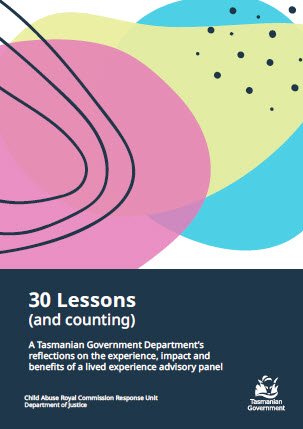
The Department created a reflective resource that captures key lessons, insights, and benefits to government workers of working with people with lived experience of child sexual abuse.
30 Lessons (and counting): A Tasmanian Government Department’s reflections on the experience, impact and benefits of a lived experience advisory panel directly reflects feedback from lived experience advocates about the experience of being part of a government-run consultation process.
 (PDF, 4.4 MB)
Child Safety and Wellbeing Policy
Our Child Safety and Wellbeing Policy outlines the Department’s approach to keeping children and young people safe and well. It was greatly enriched by valuable insights shared by Departmental employees, including the more than 420 registrants for information sessions.
The Policy creates Principles to reflect our approach to the work of being a child and youth safe organisation and represents the Child and Youth Safe Standards and the Universal Principle for Aboriginal Cultural Safety in practice.
- Leadership
- Accountability
- Inclusivity
- Responsiveness
- Continuous improvement
- Proactivity
- Child-centred
Professional Conduct Policy
The Department's Professional Conduct Policy outlines what is considered unacceptable behaviour by employees of the Department with regards to children and young people, in connection with their employment.
"(I know adults in an organisation care about my safety and wellbeing when) they listen, ask, respond and act."
— A young Tasmanian who responded to a Department of Justice survey.
Child Safe Organisation resources
The Department of Justice has developed resources to support staff to know how to create safe environments for children and young people, recognise signs of abuse and harm and report concerning behaviour.
Published resources include:
- Types of reportable conduct fact sheets to help identify different types of reportable conduct and to know what to do:
- The Perfect Leader Poster (PDF, 982.5 KB) showcases the expertise of members of Laurel House’s Lived Experience Advisory Panel for Youth and the Department of Justice’s Lived Experience Advisory Panel and illustrates things we can all do to be a leader in the eyes of a young person. We also have a plain-text version of the Perfect Leader Poster (PDF, 127.8 KB).
- More resources developed by the Department when the Framework was developed have been endorsed and included on the Office of the Independent Regulator website.
Related information
- To report a child safety concern, go to the Department’s reporting Child Safety Concerns in Justice webpage.
- Find out more about the Department’s approach to child safety and wellbeing by reading the Department’s Child Safety and Wellbeing Policy.
- Learn more about the Child and Youth Safe Organisations Framework including the Child and Youth Safe Standards and the Universal Principle for Aboriginal Cultural Safety by visiting the Office of the Independent Regulator’s website. The Independent Regulator oversees compliance with the Framework and works with organisations to improve the safety of children and young people.
"(Organisations can show me they’re safe for children and young people by) being friendly and inviting”
— A young Tasmanian who responded to a Department of Justice survey.
Recognition of Victim-Survivors
We recognise all victim-survivors of child abuse in Tasmania, including those with lived experience of harm in institutional settings.
We thank those victim-survivors who are working with us to create safer institutions, those in the victim-survivor community more broadly and those who are no longer with us.
Every child and young person has a right to be safe, and it is our responsibility to create environments where children are supported, inspired and safe from all forms of harm.